
© Javier Biosca
Article
 IDAGIO
For conductor Alondra de la Parra, Latin American music is not a single sound, but a meeting of distinct musical worlds. On Horizons, recorded live with The Impossible Orchestra, she brings together the contrasting voices of composers Paquito D’Rivera, Omar Massa, Yamandu Costa, and Sérgio Assad in a programme shaped by curiosity, collaboration, and spontaneity. In this conversation, de la Parra reflects on her Mexican roots, the creative encounters behind the album, and her ongoing commitment to bringing the extraordinary diversity of Latin American music to audiences around the world.
Latin America is often spoken about as if it were one musical culture. What gets lost in that idea?
Everything that makes it interesting. Latin America is incredibly diverse. Every country, every region, sometimes every city has its own rhythms, traditions, instruments and relationship with music.
That is something I love about Horizons. You go from Paquito’s world to Omar’s bandoneon and then to Yamandu and Sérgio’s Brazil, and they are completely different musical Languages. For me, Latin American music is not one sound. Its richness is exactly the opposite: the amount of different worlds that coexist within it.
What did growing up in Mexico teach you about music that you only understood later?
I grew up with music everywhere. At home we sang around the piano and the guitar, and at the same time I was listening to rancheras, son, cumbia, salsa, opera and symphonic music.
I think what I understood later is that, as a child, I never thought of those things as separate worlds. They were simply music. That has stayed with me. I am much more interested in what a piece has to say, where it comes from and what it makes us feel than in the category we put it in.
After so many years conducting around the world, what still feels uniquely Mexican about the way you make music?
I don’t know if I can reduce being Mexican to one musical quality. What is very Mexican in me is probably that mixture. I grew up surrounded by many different kinds of music, stories, rhythms and ways of expressing emotion, and I never felt that one had to exclude another.
Mexico gave me a very wide musical world. I think I still carry that openness with me every time I stand in front of an orchestra.
You’ve conducted everywhere from Mexico to major stages around the world. What do you hear differently when you conduct Latin American music?
There is a familiarity that is difficult to explain. Sometimes there is a rhythm, an accent or a way of shaping a phrase that I recognize almost physically because I have heard these languages around me my whole life.
But I also try to be careful with that familiarity. There is no single way to play Latin American music. Revueltas is not Márquez, Márquez is not Gabriela Ortiz, and none of them is Ginastera or Villa-Lobos. Each composer has a world of their own, and that is what I want to find.

This album brings together very different musical worlds — from the Caribbean to Brazil and Buenos Aires. What connects them for you?
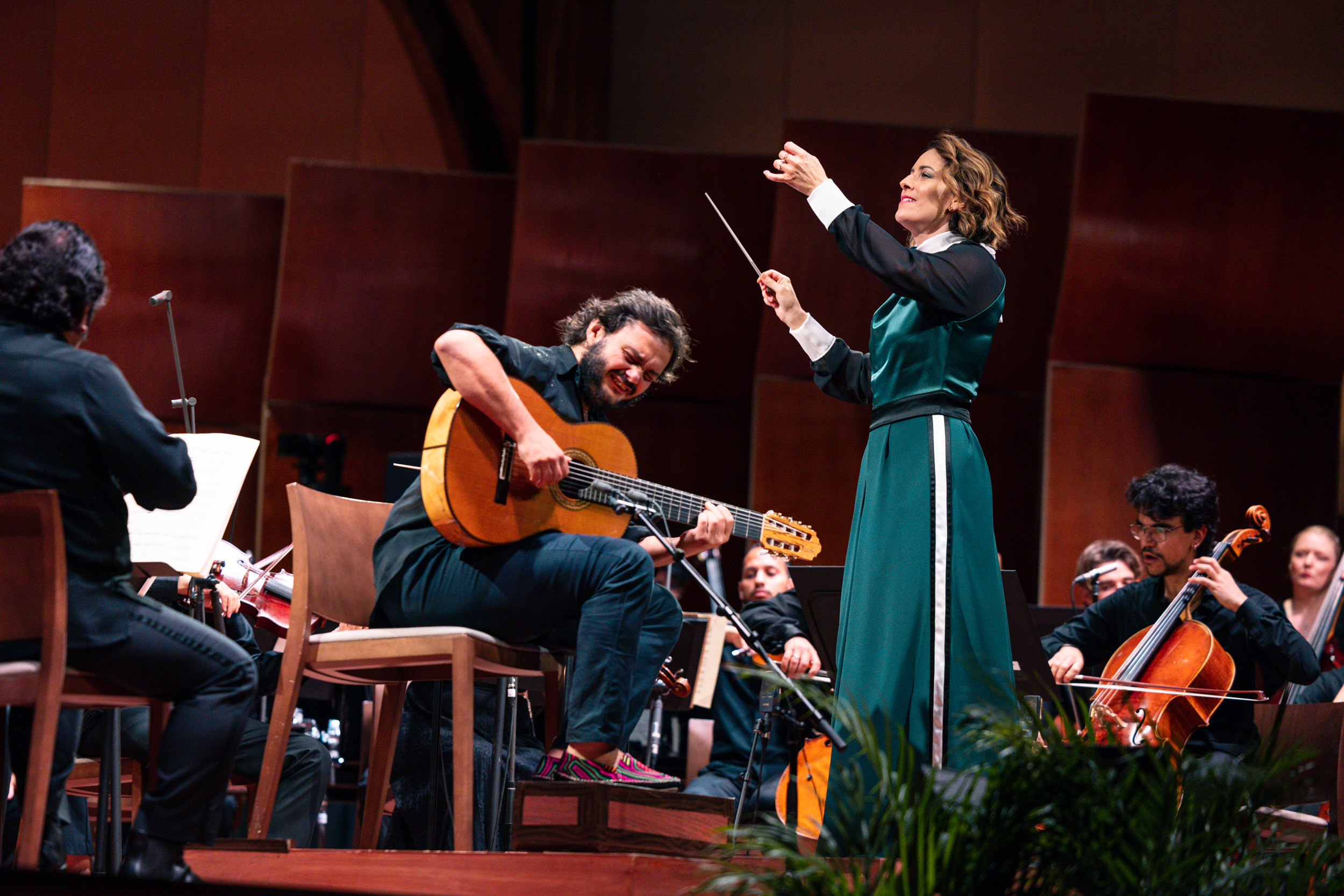
The encounter. That is one of the ideas behind Festival PAAX GNP and The Impossible Orchestra: bringing extraordinary musicians together and seeing what happens when they really listen to one another.
These three concertos don’t need to sound alike. In fact, the opposite is much more interesting. Paquito, Omar and Yamandu each bring a completely different language. What connects the album is the experience of hearing those worlds meet, live, with the same orchestra.
Did having the composers as soloists on stage change the way you approached their music?
Completely. When the person who wrote the music is also playing it in front of you, you learn things that are not written on the page. You hear how they breathe, where they want freedom, where the rhythm comes from.
With Paquito, Omar and Yamandu, there was a constant conversation between the soloist, the orchestra and me. And because this was recorded live, you can actually hear that exchange happening. There is flexibility, reaction and spontaneity that you could never plan completely in advance.
What does being part of Fuga Latina mean to you personally?
It connects very naturally with something I have cared about since the beginning of my career: creating a real space for the extraordinary music and musicians of Latin America. That is also at the heart of Festival PAAX GNP. One of the things I love most about the festival is being able to bring remarkable artists together in one place, give them time to work, listen to one another, experiment, and create things that might never happen otherwise.
Horizons was born from exactly that kind of encounter. Paquito, Yamandu, Omar and The Impossible Orchestra came together at PAAX not simply to perform a program, but to share a creative space. For me, that is one of the most exciting things music can do: bring very different voices into the same room and allow something new to emerge between them.
So being part of Fuga Latina feels like a natural continuation of that idea. It gives these composers, performers and musical worlds another space to travel, be heard and be discovered without reducing Latin America to a single sound or identity. And I love that Horizons, a project born from those encounters at PAAX, is helping open that collection.
What do you wish the world understood better about Latin American music?
That there is so much more to discover. There are extraordinary composers, orchestral traditions, chamber music, songs, dances, experimental languages and completely new music being written today.
And I also think the separation between “classical” and “popular” music can sometimes make us miss something essential. In Latin America those worlds have always spoken to one another very naturally. You hear that constantly in the repertoire.
Do you feel that Latin American composers are being heard differently today than when you began your career?
Absolutely. When I started working on this repertoire more than twenty years ago, I often felt I had to explain why these composers belonged on the program. Today there is much more curiosity and much more space for them.
But for me the goal has never been to create a separate shelf called “Latin American music.” The real goal is that great pieces become repertoire. That an orchestra programs them because they belong there. We have moved enormously in that direction, and there is still a lot to discover.
What would you like someone who knows very little about Latin American classical music to take away from this album?
Curiosity. I hope everyone who listens to Horizons finishes the album wanting to hear more, to discover more composers, more voices and more of the extraordinary diversity of Latin American music.
In one album you meet a clarinet, cello and erhu in Paquito’s The Journey, Omar’s bandoneon between Buenos Aires and Berlin, and Yamandu’s seven-string guitar in the world he created with Sérgio Assad. They are completely different. And that, for me, is exactly the point.