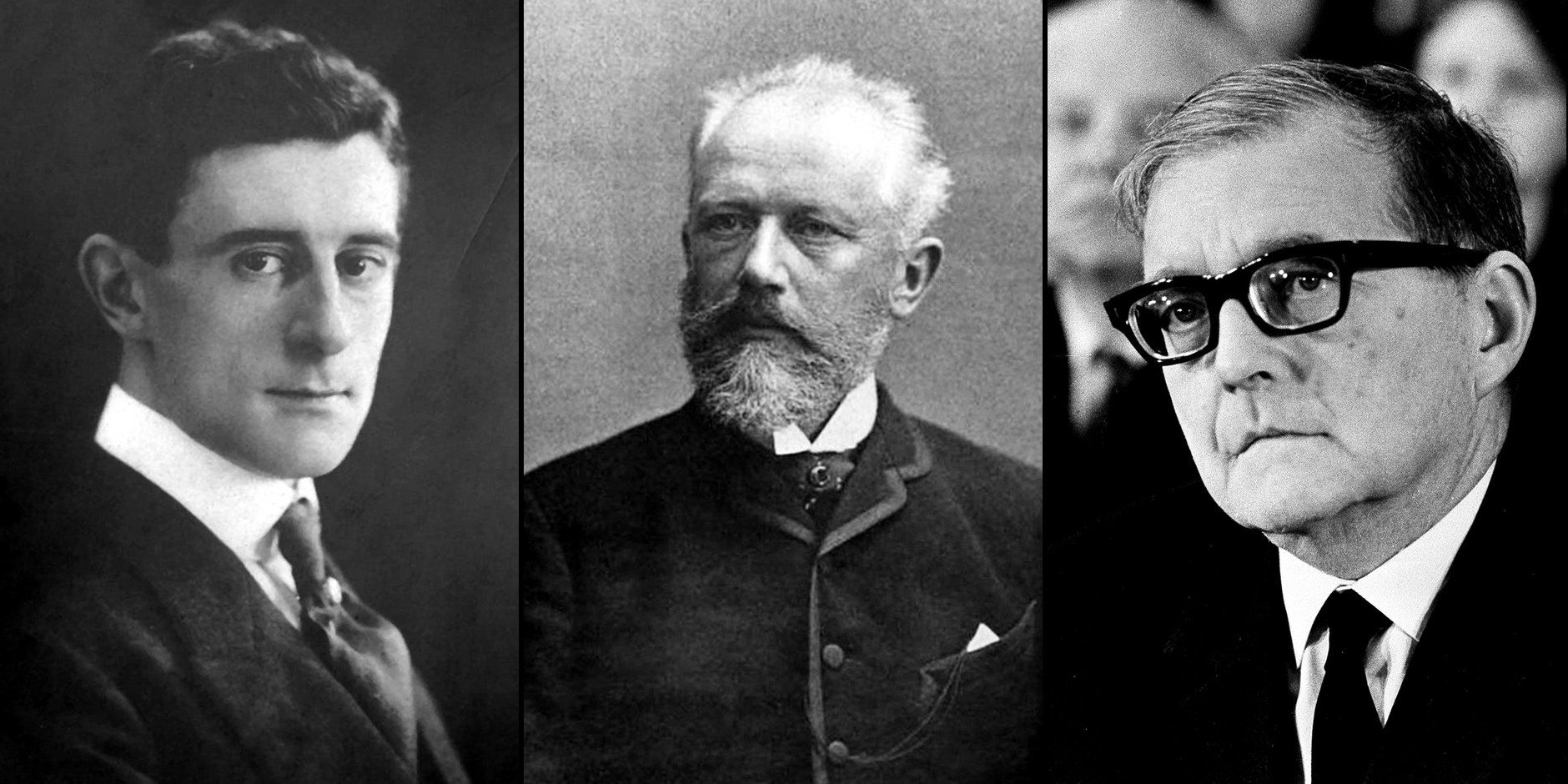
Ravel and Tchaikovsky: IDAGIO catalogue images. Shostakovich: photo by V. Mastyukov / Glavarkhiv Moskvy, CC BY 4.0 (Wikimedia Commons).
Guest Article
 Arisa Iida
Arisa Iida (Classical Music Facilitator @ Podcast "Otona no Ongaku Zanmai")
Famous musical pieces often come with stories spun by their listeners. However, in quite a few works, these stories differ from the composer's own words and thoughts, or have been re-evaluated through later research. The three pieces lined up in this program are precisely such works.
Let us unravel the stories these pieces have traversed while keeping our interest focused on the "discrepancies" that have arisen between what the composers poured into their music and what we, as listeners, have received.
The starting point for this piece's conception dates back to 1906. Around this time, Maurice Ravel was conceiving a tribute to Johann Strauss II, the King of the Waltz, under the title "Wien." He described the concept as "an apotheosis of the Viennese waltz, mingled with the impression of a fantastic and fatal whirlwind." Could it be an expression of the intoxication felt as the elegant court waltz is polished to its utmost beauty, while the dancers lose themselves and are swallowed up?
Work on it was interrupted, but after a gap spanning the First World War, his pen began to move again in 1919, and over the following year the piece came to fruition as a masterly orchestral work. An elegant waltz gradually transforms into an irresistible, giant whirlwind. The score written by Ravel includes notes to the effect of "Through swirls of clouds, couples dancing the waltz can be dimly made out" and "Imperial Court, about 1855."
Coming at a time when the scars of the First World War were still raw, critics of the day eagerly projected allegories of the collapse of the old empire or a "Danse Macabre" onto this music, trying to interpret it as a tragedy of the era's destruction. However, Ravel himself, as recorded in interviews from the time, firmly rejected such symbolic over-interpretations. What he spoke of was the hallucinatory ecstasy itself, in which the dancers become intoxicated by the waltz and are carried into euphoria.
Originally, this piece was completed as ballet music commissioned by Sergei Diaghilev, leader of the Ballets Russes. However, upon hearing the completed score, Diaghilev declined to stage it, saying, "It is a masterpiece, but it is not a ballet. It is a portrait of a ballet." Refused staging in a theater, this music was first heard on December 12, 1920, at the Salle Gaveau, a concert hall in Paris, performed by the Lamoureux Orchestra conducted by Camille Chevillard.
The highlight is, first and foremost, the opening. Amidst sounds like enveloping clouds, fragments of a waltz can be faintly glimpsed. Then, each time the same melody returns, the tone color subtly changes. This is orchestration worthy of Ravel, who earned the sobriquet "The Wizard of Orchestration." The music eventually loses its rhythmic footing, and a dizzying whirlwind arises. Whether you sense a premonition of catastrophe in it or think of the shock that comes at the end of intoxication — the answer is left entirely to the listener's ear.
On Christmas Eve of 1874 (Old Style Russian calendar), Pyotr Tchaikovsky unveiled this new concerto in a two-piano version at the Moscow Conservatory to his close friend, the pianist Nikolai Rubinstein. According to what the composer later wrote in a letter, the feedback from Rubinstein was harsh criticism, calling it "unplayable" and "clumsy." Deeply hurt, Tchaikovsky declared on the spot, "I will not change a single note before publishing it," and settled on the master pianist Hans von Bülow as its dedicatee.
What was the result? In October 1875, the world premiere in Boston with Bülow as soloist was met with enthusiastic acclaim. At the Moscow premiere in December of the same year, Sergei Taneyev served as soloist, and amazingly, none other than Rubinstein stood at the conductor's podium. Furthermore, in 1878, he performed this concerto as soloist himself. In other words, the initial rejection was by no means the end of the story, but merely a dramatic opening chapter.
At the opening, full piano chords respond to the call of the horns, and the strings sing out a grand theme. Yet, this magnificent melody is played only twice at the very beginning and never returns in the main body of the work (this might be one reason why Rubinstein, who valued classical formal beauty, judged it "clumsy"). It is an overwhelming luxury to spend such a melody so freely and then let it go.
Furthermore, the first movement incorporates part of a melody Tchaikovsky heard from a blind singer in Ukraine; a Ukrainian folk song is hidden in the final movement, and a French popular song in the second movement. If you listen closely, you can enjoy it as if peering into a jewelry box of melodies collected by Tchaikovsky.
In January 1936, Pravda, the official newspaper of the Communist Party of the Soviet Union, fiercely attacked Dmitri Shostakovich's opera Lady Macbeth of the Mtsensk District. Stalin had attended a performance and was enraged by it; this led to the publication of a critical article titled "Muddle Instead of Music."
In the background was the rapid tightening of ideological control in the Soviet Union. The experimental, avant-garde artistic freedom that followed the Russian Revolution had come to an end, and under Stalin's dictatorship, easy-to-understand art praising the state — so-called "Socialist Realism" — was being forced upon artists as an absolute dogma. This was also a time when the madness of the Great Purge was spreading, eliminating dissidents one after another. Straying from the party line meant not just simple criticism, but a deadly danger that could literally cost one's life. Receiving this critique, which was effectively taken as a "death sentence," Shostakovich cowered in fear of arrest and sealed away his near-complete, highly avant-garde Symphony No. 4 in the back of his desk (it did not see the light of day until 1961). It was amidst despair, with his life and artistic survival at stake as if a blade were held to his throat, that he composed this Symphony No. 5 between the spring and summer of 1937.
On November 21 of the same year, the premiere in Leningrad took place under the baton of Yevgeny Mravinsky. The applause lasted for a long time, and it is reported that some in the audience wept during the third movement, Largo. Later, a statement attributed to the composer appeared in a newspaper, calling it "a Soviet artist's practical creative response to just criticism," which became the official interpretation.
However, is the triumphant brilliance at the end of the final movement truly pure joy? Testimony, published in 1979 and presented as the composer's memoirs, describes this as "forced jubilation." Yet, the authenticity of this book itself has been debated among experts for many years, and the controversy over the composer's true intent remains unresolved to this day.
From the first movement beginning with sharp leaps in the strings, to the second movement, an ironic dance, through the third movement like a deep prayer, to the dazzling D major chord of the finale. Even nearly ninety years later, the music quietly asks us what that day's applause was truly for.
What these three stories have in common is that once a work leaves the composer's hands, it continues to live dynamically, changing its meanings within the listener's ears. What kind of sound will Jaap van Zweden, the Evergreen Symphony Orchestra and piano soloist Eric Lu draw from these three pieces? We hope you will come to the concert hall and hear it with your own ears.
Hong Kong Philharmonic Orchestra, Jaap van Zweden (conductor), Niu Niu (piano)
Hong Kong Philharmonic Orchestra, Jaap van Zweden (conductor)
OSAKAThe Symphony Hall
Wednesday, October 28, 2026 — 7:00 PM start (doors 6:00 PM)
S seats ¥10,000 / A seats (Sold Out) ¥5,000 (all seats reserved, tax included)
KYOTOKyoto Concert Hall, Main Hall
Friday, October 30, 2026 — 7:00 PM start (doors 6:00 PM)
S seats ¥10,000 / A seats (Sold Out) ¥5,000 (all seats reserved, tax included)
Header image: Dmitri Shostakovich, photo by V. Mastyukov / Glavarkhiv Moskvy, CC BY 4.0